Whether you love horseback riding or have a kid obsessed with riding the saddle, there are some unique places around the world to hop in the saddle.
Safari on Horseback
Imagine riding in a field alongside zebra and antelope, with the roar of lions in the distance. Many companies offer horseback riding safaris, but the multi-day or multi-week commitment is often more than a casual rider can tolerate.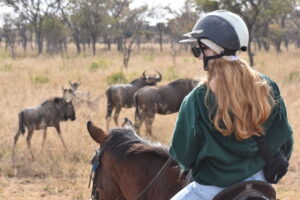
Enter Colins Horseback Africa, giving riders the same experience in just a few hours. Located in Pretoria, about an hour train ride north of Johannesburg, Colins offers horseback riding, lion treking, dining, and overnight stays, all on their private game reserve.
Our horseback safari began on our first full day in Johannesburg, a few days before a visit to Kruger National Park. It was a great option to ease into the new time zone, and to get a taste of the wildlife before reaching the park.
To get to Colins, we took an early 30-minute train from Johannesburg to the Hatfield station, north of Pretoria. A hired car delivered us to Colins, about a 45-minute drive. When we arrived, we took the short walk to the barn, passing lions pacing against the edges of their enclosures. As we received our instruction, we could hear the lions chuffing nearby.
Beyond our family of four, we were joined by a couple who didn’t appear to be comfortable on horseback, and as we embarked they seemed to be battling nervousness with their desire to see wildlife. The horseback ride wasn’t exactly a traditional nose-to-tail experience; instead we were able to wander apart in the fields a bit, and even trot or gallop at our comfort level under watchful eyes of two guides.
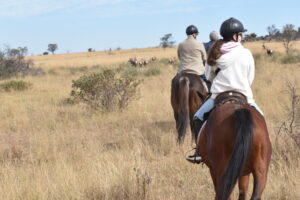 Despite the option to ride more quickly, the overall pace was kept slow enough for everyone to stay in line even when they were barely comfortable traveling at a walk. Our tree-lined path led past dogs and baboons, eventually opening onto a large field of antelope and zebra. The horses slowly approached them, as their ears warily twitched back and forth before finally deciding we weren’t worth the interruption of their grassy meal. Cameras out, we snapped photos from various angles as we were slowly guided to another field full of wildebeest.
On our return route we saw a few more quadrupeds, though we missed the oft-spotted giraffe who decided to spend the morning in another area. After our ride we had a bite of lunch, still savoring the taste of an African safari that was a perfect appetizer for our trip.
Along the Grand Canyon
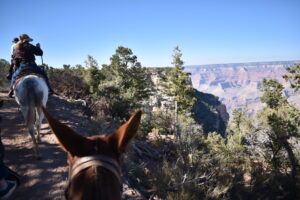 Sure it’s not technically horseback, but riding the back of a mule along the rim of the Grand Canyon is beyond incredible. These surefooted equines have an ability to navigate the rocky paths with nary a stumble, providing riders an easy and unique view of the canyon far below.
Reservations are required and can be filled months in advance. Because riders must check in a day in advance to confirm their spot, it’s a perfect activity after spending a day exploring the museums along the South Rim and watching the sunset the night before.
The tour begins at the Grand Canyon Village Mule Barn. That’s where you’ll join the usually large group of visitors to meet your mule. After hopping in the saddle, we began our journey through the brush, slowly making our way to the canyon’s edge.
The mules ride nose to tail, so the trek isn’t difficult even for beginners. However those with a significant fear of large mammals should reconsider any horseback riding activity. Those with a significant fear of heights should be fine; the trek nears the canyons edge but the path is wide enough for comfort.
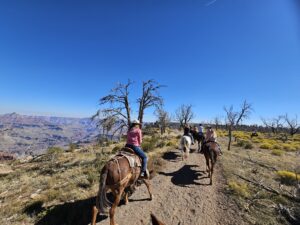 Occasionally the mules decide to trot, which is bumpier than horseback. With the western saddle posting wasn’t much of an option (for those who know how to post on horseback); trotting on a mule can be a bit painful for the posterior. The ride paused many times for photo ops, giving our derrières a bit of a break. Though the trek is brief, it provided lots of laughs, entertainment and an unusual memory for our family.
Once on this Island…
For a ride that’s completely up to you, visit Mackinac Island, located in northern Michigan near the bridge to the Upper Peninsula. Among things like fudge and the film Somewhere in Time, Mackinac is known for having no automobiles.
And so, horseback riding suddenly becomes easier. While they offer trail rides, it’s also possible to simply rent a horse as one might rent a car. Jack’s Livery Stable offers options up to two hours, but we found one hour was sufficient since the island is relatively small.
Our biggest question was where to go. We had no idea where to explore or what to do if we got lost. When I asked the livery hand if he had a map, he noted that it’s an island. “When you hit water, turn around.” As we soon discovered, it was simple to follow the roads, and when we were confused the horses truly knew their way back.
French Cowboys
I had one thought while inhaling the brackish air as my horse galloped through a marsh past flocks of seagulls: this is so cool.
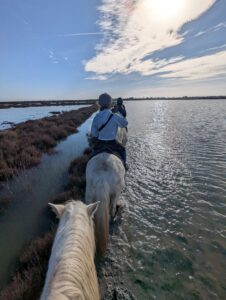 Southern France is known for lavender, Provincial wines, and towns like Avignon and Marseille. Lesser known is a region called the Camargue, home to one of the oldest breeds of horses in the world. This hardy breed is known for its small stature, grey coat and ability to hold its nose underwater, a trait that evolved so it could eat the underwater grasses of its marshy environment.
The region is full of places to ride horses. These farms, known as “Mas” in French, are primarily located around the towns of Aigues-Mortes and Saintes-Marie-de-la-Mer. A car is required to reach the Mas, but the area is full of small towns and country roads, making driving relatively simple with GPS.
We chose to stay at Mas de la Grenouillere (aka Frog Farm), with lovely rooms and the option of horseback riding lessons. The first evening my daughter had an entire lesson in French (which she’s taking in school) and decided that Michele provide her one of the best lessons she’d ever had, despite understanding only about half of what he said.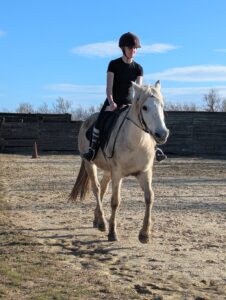
The next morning we joined one other experienced rider and our English-speaking guide for a three-hour trek to the marshes and beaches. While I’m accustomed to being an average rider, being among very experienced riders was new; I was definitely the weak link of our group.
We set out from the Mas, soon seeing several water birds as we walked past other farms saddling their horses for their own tours. Soon we reached a small pond with our first wild flamingo. About half an hour later we came upon a larger flock, where we slowly approached them as we crossed the marshy area.
Eventually we reached a large marsh filled with flamingo, where we galloped through the knee-deep water (for a horse) on our way to the nearby beach. We soon had to return, spotting the same flocks once again and seeing even more water birds like egrets, cranes, storks and ducks.
The Camargue horse is utilized by the local French Cowboys, known as Gardians, to herd the bulls and cattle. The horse and rider are celebrated in Saintes-Marie-de-la-Mer each year in mid-July. While we missed the event, our guide shared details with it that convinced me we must return someday to experience it firsthand.